There is a particular kind of tiredness that no amount of coffee fixes. You wake up having slept eight hours and still feel like you carried something heavy to bed. Then you sit down at your desk and by lunchtime the ache has arrived again, somewhere between the shoulder blades or low in the small of your back. For years I treated this as an unavoidable part of being an adult who sits too much. It is apparently not — and the company that has made me think hardest about that is Percko, a French brand whose entire catalogue is organised around one blunt promise: nos produits pour soulager le dos — products to relieve the back.
What makes Percko interesting on a home blog is not that it sells mattresses, because plenty of companies sell mattresses. It is that the brand treats back comfort as a property of the room you live in rather than something you go to a clinic for. Bedding, pillows, office chairs, a patented posture bra, and a range of shirts and vests with built-in tension systems. The through-line is that a house quietly shapes your spine for eight hours a night and another ten at a desk, and that both deserve the same attention you give your kitchen.
The brand, in brief
Percko is French, and its range is made largely in France — the bedding carries a literie faite en France claim. It has been trading long enough to accumulate the sort of unglamorous credibility that actually matters in this category: a stated rating of more than 4,000 customer reviews, and a professional arm that the company says serves more than 2,500 businesses. There is also a meaningful French retail channel that is almost invisible from the English-speaking world: a presence in pharmacies, alongside the usual direct website.
Two product claims define the range. The shirt is marketed as le T-shirt le plus reconnu par les médecins — the shirt most recognised by doctors — and it carries a medical-device classification. The bra is billed as le premier soutien-gorge breveté qui allie posture et maintien, the first patented bra combining posture and support. Both products work on the same principle: rather than pulling you into a corrected position, a tensioned panel across the upper back gives your postural muscles a reminder and a gentle assist, so that holding yourself upright takes less conscious effort.
That distinction matters more than the marketing suggests. A rigid brace corrects you by doing the work for you, and your muscles atrophy out of the habit. A light tension system nudges. If the underlying idea is sound, you should feel it working after you take the thing off.
Start with the eight hours you cannot opt out of
If your problem is waking up sore, the bed is where I would spend money first, and Percko's approach is to treat the mattress and the base as a single system rather than selling you one and letting you guess about the other. Their zoned bases (sommiers zonés) are the differentiating part: instead of a flat platform, the base flexes in sections so that the spine is supported differently at the shoulder, the lumbar, and the hips.
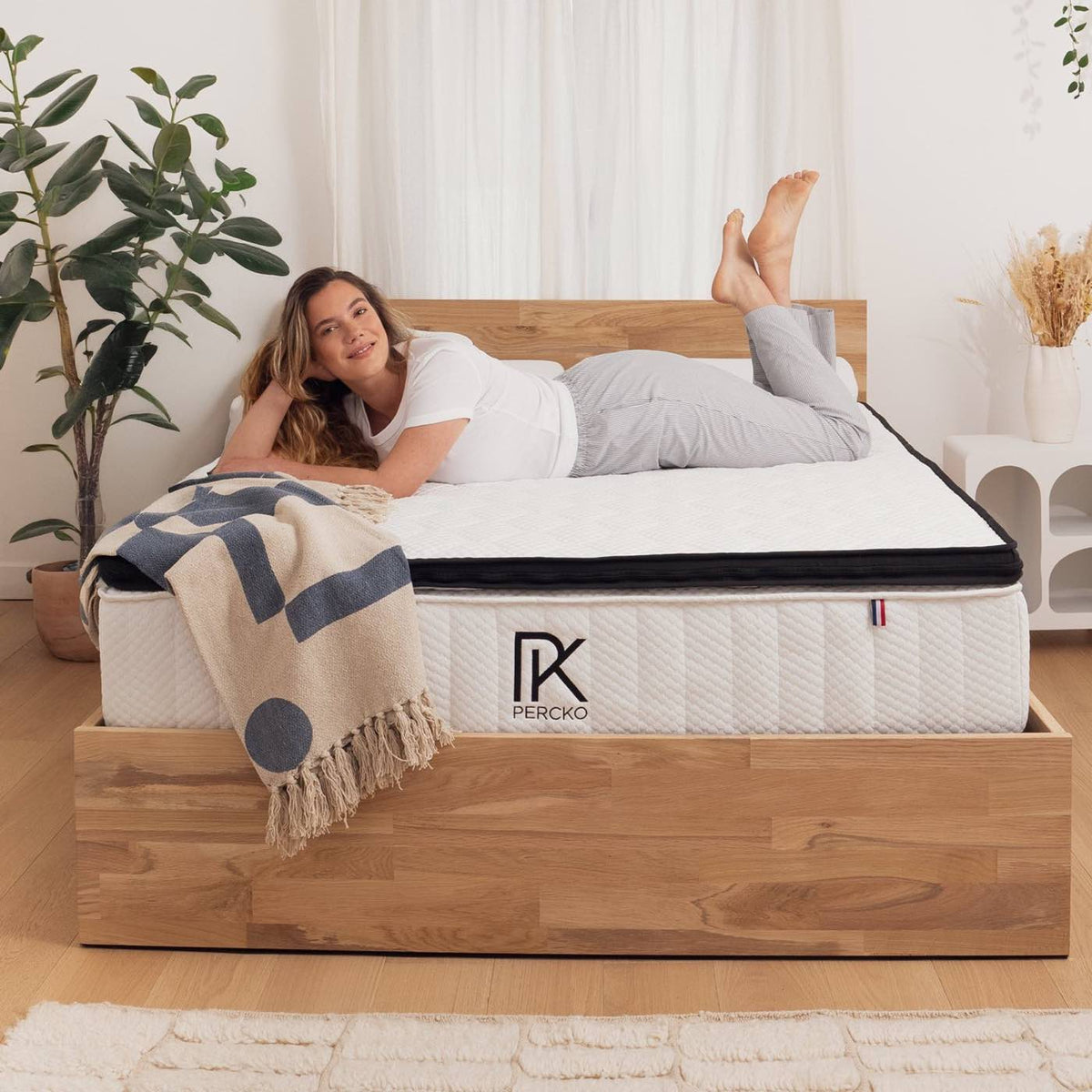
On top of that sit three mattress options. The hybrid (€999) pairs springs with foam for people who run warm or move a lot in their sleep. The memory foam model (€675) is the softest and the cheapest of the three, and the sensible choice if you sleep on your back or side and like the feeling of being held. The Signature (€1649) is the flagship, and the one pictured above — the zoned support, the natural materials, the whole thing built as a proper piece of French bedroom furniture rather than something you hide behind a bed skirt.
If you already have a good mattress and are not ready to replace a four-figure object, the far more accessible entry point is the topper (surmatelas, €279) and the pillow range. Percko makes three pillows — a flat one, a universal one, and a "Dorsal+" model for people who sleep on their front or who want more lumbar support. All of them sit at €79–99, and there are dedicated pillowcases at €35. This is the version of the experiment I would actually recommend: a €79 pillow tells you within a month whether the brand's theory of support suits your body, for a fraction of the risk.
Then the desk, which is where most people actually break
If you work from home, your chair is arguably a more important ergonomic purchase than your mattress, because you sit in it for roughly a working day and you only sleep in your bed. Percko's ergonomic chair (€599) and its gaming chair (also €599) are built around the same premise: keep the pelvis tipped slightly forward, let the feet reach the floor flat, and support the lower back continuously so the spine does not have to hold itself up by bracing.
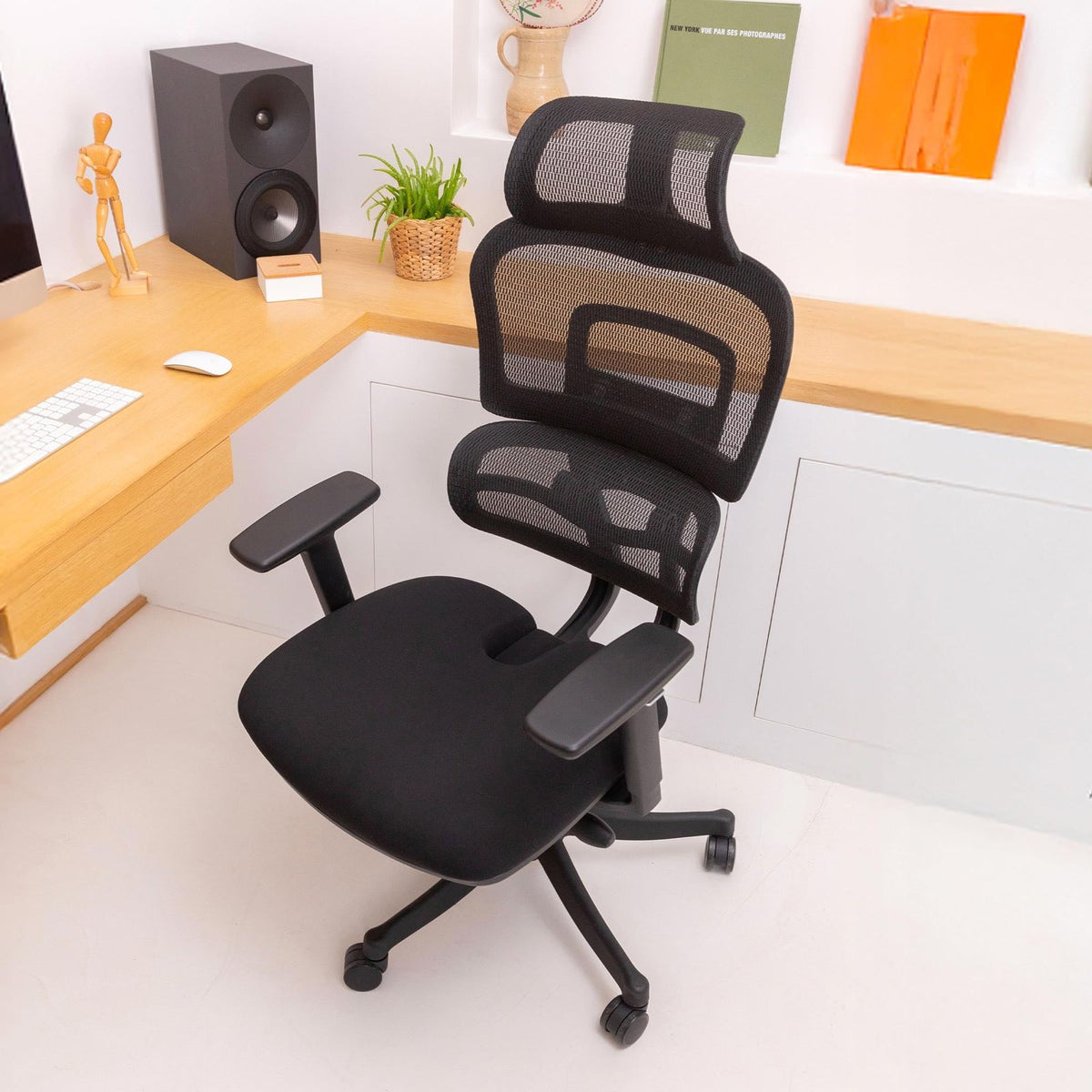
The chair is the single piece in this range I would tell anyone to try regardless of brand loyalty, because it is the one intervention with an unusually well-established evidence base behind it — the relationship between sustained slouched sitting and lower back pain is about as well documented as anything in this field gets. What you are buying with the Percko version rather than a €150 Amazon chair is adjustability across a genuinely wide range, mesh that does not trap heat, and armrests that can actually be repositioned rather than merely raised.
There is a smaller item worth knowing about, too: the Loop massage wheel (€29), a rolling tool for massaging the muscles either side of the spine. It is the least sophisticated thing Percko makes and it is the one I have reached for most often. For the price of two coffees, you can self-massage the areas that desk work tightens, and doing it on a sofa in the evening is a genuinely pleasant thing to do.
The shirt and the bra are the interesting idea
Now to the products that make Percko unusual, and the reason I wanted to write about the brand rather than just list its price tags.
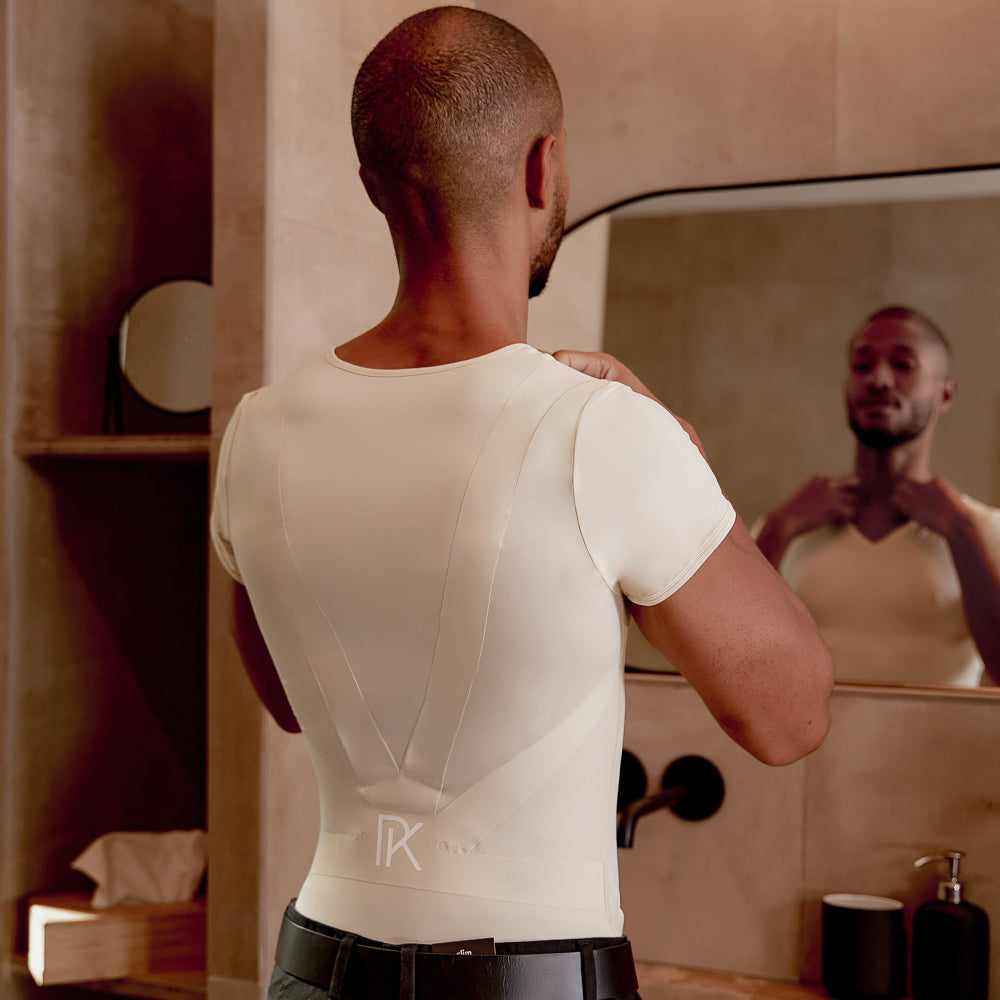
The posture-support shirts come in men's and women's versions at €129, in a discreet style that reads as an ordinary fitted t-shirt, plus sports versions and a practical vest at the same price. The construction is what separates them from the endless crop of "posture corrector" braces: instead of rigid stays that force your shoulders back and hold you prisoner, a panel of tensioned fabric across the upper back and shoulders pulls gently into alignment. You are aware of it — that is the point — but you can move, breathe, and reach for things without the feeling of being strapped into a cast.
The patented posture and support bra (€89) applies the same logic to the other half of the population, and it is the product I would most want a female reader to look at, because the statistics on women reporting back pain are considerably worse than men's and the category has traditionally offered them very little. In practice it does two jobs at once — it supports the bust and it pulls the shoulders back — which is why the combination of posture and support in the product's own name is doing real work rather than just marketing.
There is an honesty test worth applying to both. Do they make you stand differently, or do they make you feel like you are standing differently? The first is an intervention; the second is a placebo with a price tag. Percko's lightweight tension approach is, structurally, the first kind — which is also why it is worth choosing over the €30 brace that looks aggressive and mostly holds its own shape regardless of what you are doing underneath it.
What the evidence actually supports — and what it does not
I would rather be straight with you about this, because the ergonomics aisle is thick with promises that do not survive contact with a real human spine.
Percko states that 88% of surveyed mattress users experienced reduced pain. That is a figure from the company's own internal qualitative survey, not from an independent clinical trial, and it should be read as a customer-satisfaction signal rather than as medical evidence. The company does make an external medical-device classification claim for the shirt range, which is a stronger kind of claim than a review average, but the supporting detail is not something you will find summarised on a product page. Similarly, the testimonials the brand publishes are, like every brand's, curated.
What is genuinely well supported, independent of Percko, is more boring and more useful: that mattresses and bases with differentiated lumbar support help some people with back pain, that a supportive chair reduces load on the lower back during prolonged sitting, and that the best interventions are usually cumulative and boring rather than dramatic. Nothing about Percko's range contradicts that evidence. Its genuinely novel contribution is applying it consistently across sleep, sitting, and daytime wear — which is more coherent than most ergonomics catalogues, most of which sell a lumbar cushion and call it a programme.
This is, of course, not medical advice, and if your back pain is sharp, radiating down a leg, or has arrived alongside numbness or weakness, a physiotherapist will help you more than any product on this page.
The practical bits: price, delivery, and how to buy
The range spans €29 to €2,249, and the price distribution is worth understanding before you click anything. Cheap items — the massage wheel, pillowcases, pillows — are genuinely impulse-purchase territory. The shirts and bra sit in the low hundreds, and are the easiest way to test whether the brand's philosophy appeals to you. Mattresses and zoned bases are serious money, and the brand bundles them aggressively with discounts of up to 45% when bought as a pair.
Two practical points that make a French brand much easier to buy from abroad. Financing is offered through Alma at up to 4 interest-free instalments, which is how most people will end up buying a mattress at all. And the company advertises a satisfait ou remboursé guarantee, alongside a 30-day trial on the mattress range, which is a reasonable cushion for spending four figures without lying in the thing first.
My own suggestion, if you want a low-risk way in: buy the €79 pillow and the €29 massage wheel. Sleep with the pillow for a month. If mornings improve, the case for the mattress is worth making — and if they do not, you are out about the price of a decent dinner and you have lost nothing but the knowledge that you are not a sleeper who responds to support upgrades.
The verdict
There is a lot of ergonomic branding in the world, and most of it is expensive theatre. Percko is unusual in that the expensive theatre is largely absent: the products are plain, the claims are French and a little direct, the price ladder is honest about what is a considered purchase versus an impulse, and the whole range is trying to solve one problem rather than forty.
For a home that is meant to be restful — and the honest truth is that most of us treat the bedroom as somewhere we pass out at the end of the day rather than as a piece of interior design — it is a genuinely useful reframe. Your bed and your desk are the two pieces of furniture you use more than any others. Spending on them is not indulgence. It is the least glamorous and most reliably effective home upgrade available.
If that sounds like the sort of quiet, unglamorous fix your house has been waiting for, the full range is here: 👉 Explore Percko mattresses, chairs and posture support