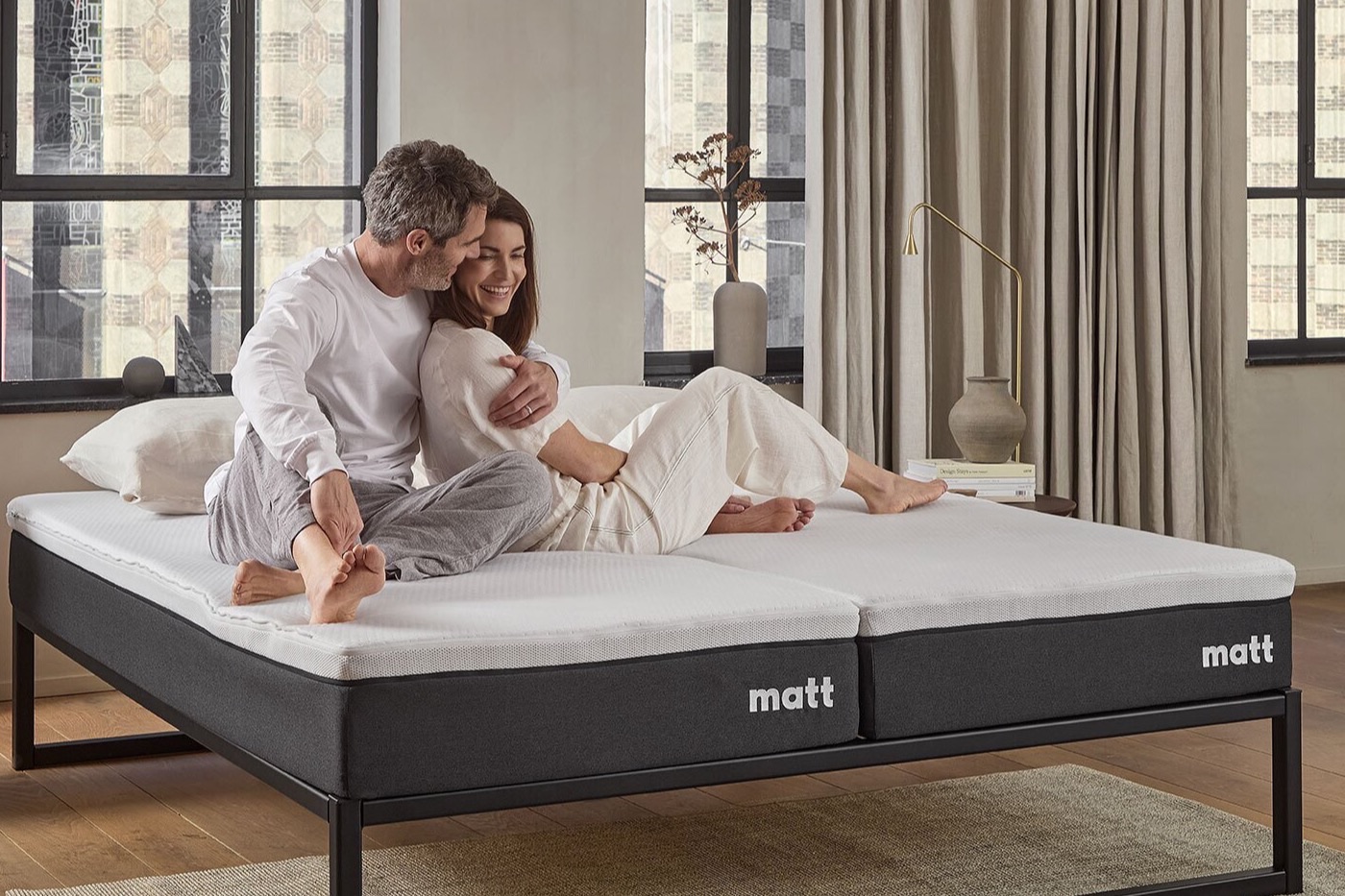
Most of the rooms in a house are a negotiation. The kitchen has to work around a wall you cannot move, the bathroom works around plumbing that predates you, the living room works around a sofa that was chosen in a hurry and has been a compromise ever since. The bedroom is the exception. It is a box, it holds a bed, and almost nothing about it is fixed in place. Which is why it is strange that the piece of furniture people spend a third of their life on is usually the one they think about least.
Matt Sleeps — matt, on the French site — is a Dutch bedding brand that has built its entire business on that gap. Its flat mattresses ship with six firmness levels and a zip, so you open the cover and change how hard the bed is yourself. Its flagship goes considerably further than that. If you are redoing a bedroom rather than just replacing a mattress, the range also covers bases, storage beds, boxsprings, pillows, duvets and the linen on top of all of it.
What follows is an honest read of the range: what the engineering actually is, what it costs now, and where the marketing outruns the product.
The brand in brief
Matt Sleeps started in Amsterdam and grew out of a very ordinary domestic argument. The founder, Joep, and his partner wanted opposite things from a mattress — she wanted firm, he wanted soft — and every brand on the market sold one and only one answer. Fifteen months, dozens of prototypes and a collaboration with sleep researchers at TU Delft later, the first adjustable mattress with six firmness levels launched. Development involved four European manufacturers, three hotel groups, and 260 supposedly fussy sleepers at the Art'Otel in Amsterdam who tested the thing before it shipped.
The awards are unusually concrete by mattress-industry standards. The Consumentenbond, the Dutch consumer association that is the rough equivalent of Que Choisir, named matt the best mattress in the Netherlands five years running. The Financial Times put the brand in its FT 1000 list of fast-growing European companies in 2022, and Joep was named EY's Dutch entrepreneur of the year the same year. Those are external bodies with no commercial stake in the conclusion, which is not something you can say about most mattress badges.
The manufacturing story is European but not French. Everything is developed in what the brand calls its best workshops in Portugal, and all of the foams are produced in Europe with CertiPUR and OEKO-TEX certification. The adhesives used are water-based, no animal products go into the build, and every layer is tested each production run. Worth being precise about the limits of that: "developed in Europe" is a broader claim than "made in France," and the French site is a French-language shopfront rather than a French factory.
The core idea: a mattress you adjust rather than choose
Almost every mattress purchase is a single, irreversible guess made in twenty minutes. You lie on something in a shop for four minutes, or you read a comparison table, and then you commit to a firmness that has to serve you for a decade — through weight changes, injuries, a pregnancy, a partner moving in.
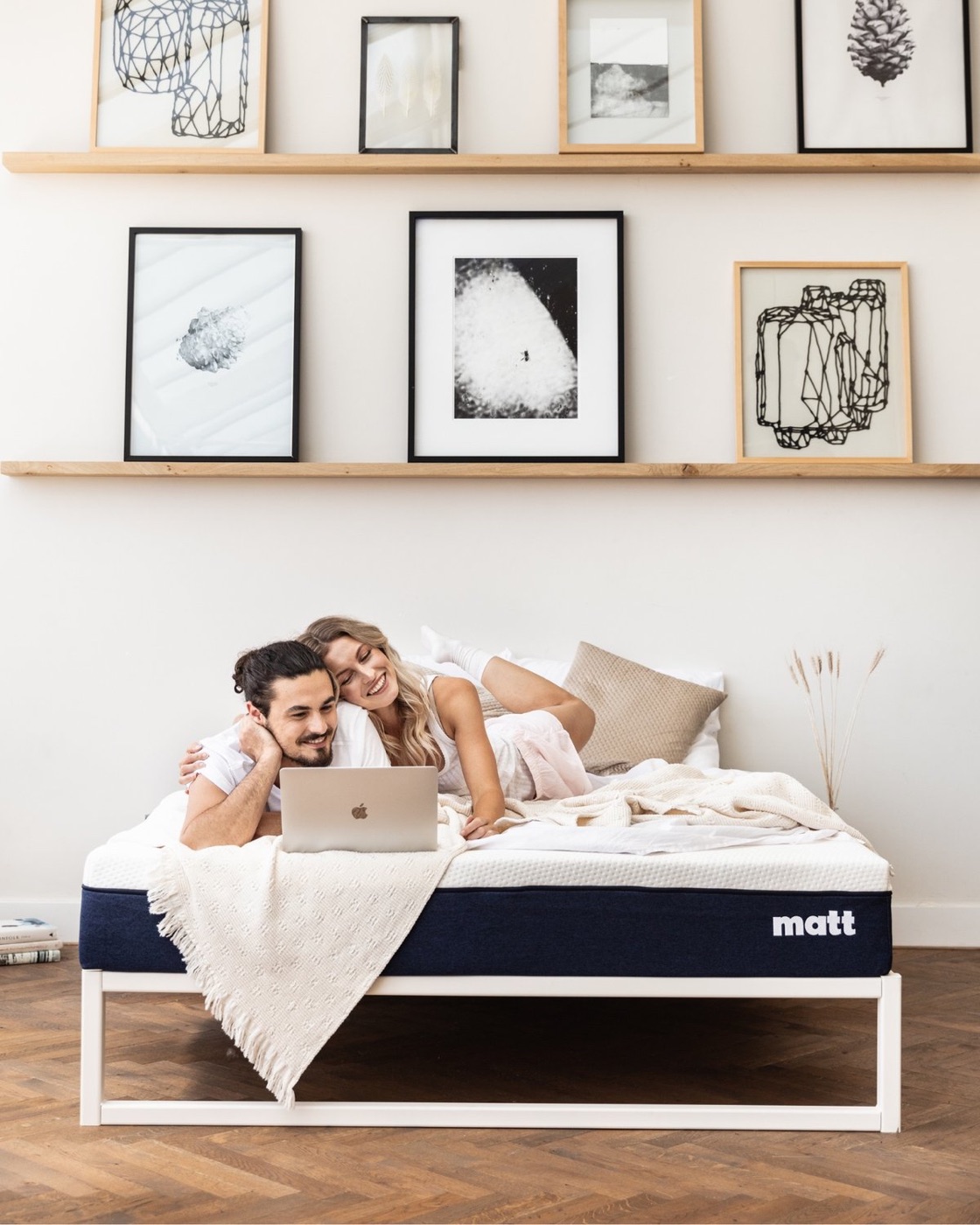
Matt's answer is mechanical rather than clever. The Original is 25 cm thick, built from five layers of CertiPUR and OEKO-TEX certified foam, and it ships in six firmness levels with the mattress delivered at level 3, the middle. If level 3 is not right, you unzip the cover and swap the layers inside. Your partner can have a different level on their side, on the same mattress, with no gap down the middle.
The supporting details are the part that tells you whether this is a real product or a gimmick. High-resilience HR foam carries the load and keeps the spine in the position it would be in standing up. The company says it measured support across 36 pressure points on different body types and sleeping positions, and that seven comfort zones provide the ergonomic posture. Most of the range, including the mattresses here, isolates movement so a partner rolling over does not drag you across the bed — the brand's own joke about this is that snoring is not included.
That zipper is the whole pitch, and it is a genuinely different proposition from "buy firm or buy soft." It moves the decision from the shop, where you have four minutes and bad lighting, into your own bedroom, where you have a hundred nights and a body that will tell you the truth.
The Original: prices and the size question
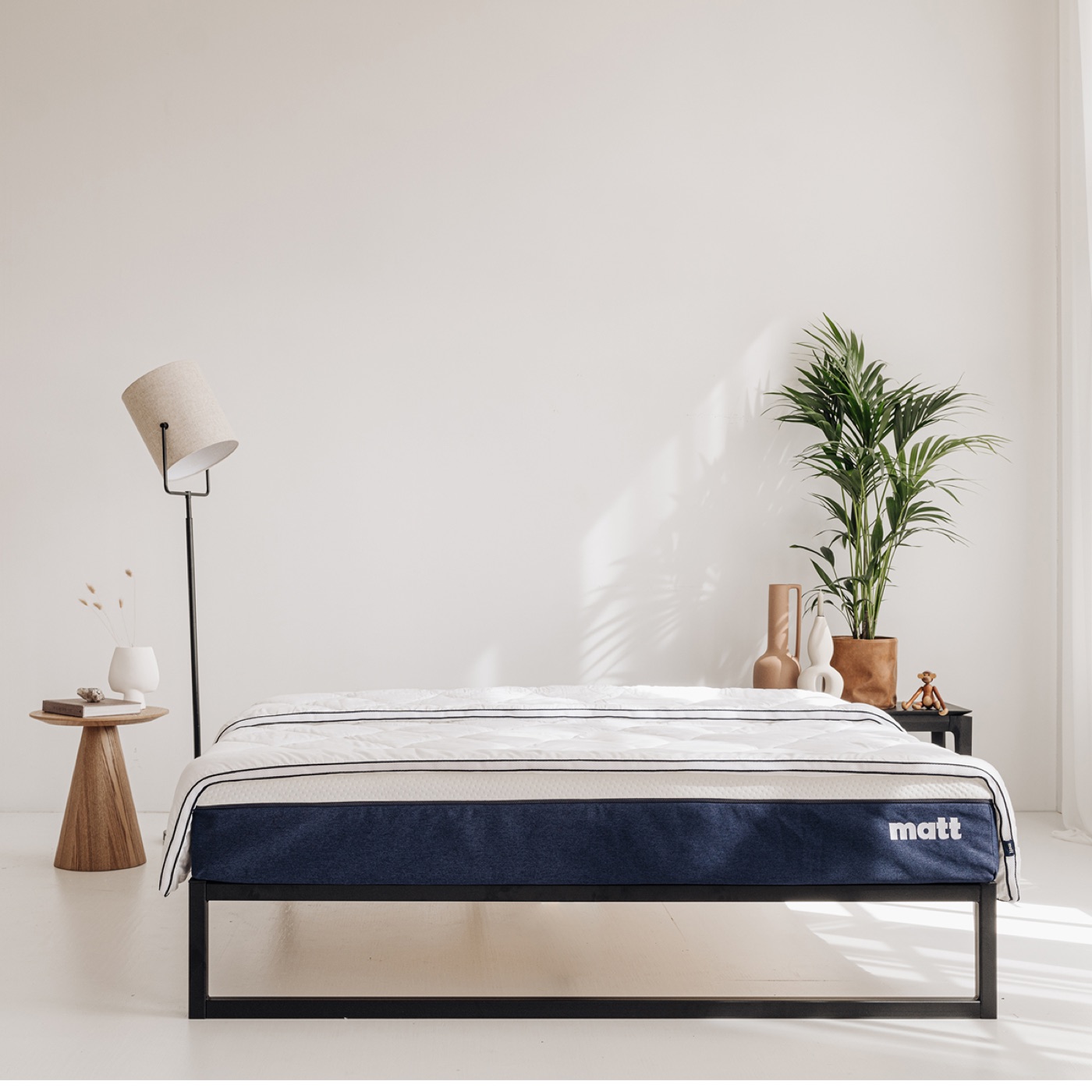
This is the sensible entry point, and the current pricing is legible enough to plan around. In the French store, the Original in 90×190 is €417.50, 140×200 is €694.50, 160×200 is €788.50, 180×200 is €880 and 200×200 is €982.50. The non-standard lengths — 210 cm and 220 cm — exist too, priced up accordingly, and if you have an older French bed frame with odd proportions this matters more than any spec sheet.
Two practical notes on those numbers. The first is that "from" always means the smallest size, so the gap between the entry price and what you will actually pay for a double is large. The second is that the size decision deserves more thought than the model decision: the difference between the 140 and the 160 is about €94, which is cheap compared to spending a decade on a mattress that is 20 cm too narrow for two people.
The trial terms are the reason buying a mattress online is a reasonable idea at all. 120 nights, free, starting the day the mattress is delivered. If it is not right you book a return, they collect it, and you are refunded. Ten years of warranty sits behind it. Delivery is free and returns are free, though the delivery window is quoted inconsistently on the site — three to five working days on the product pages, five to eight in the footer — so plan for the longer number.

The Hybrid Pro: the one for people who are genuinely fussy
If the Original is a clever compromise, the Hybrid Pro is the version for someone who has given up on finding a mattress that suits them.
It is built from ten independent modules of pocket springs, each rated at one of five firmness levels, and you configure the mattress zone by zone — shoulders, back, hips — rather than as one block. Each module holds up to 39 individually wrapped springs, heat-treated to resist metal fatigue, set at roughly 300 springs per square metre, 14 cm tall, 60 mm at the waist, 5.75 turns. The wire gauge, from 1.5 mm to 2.1 mm, is what sets the firmness: thicker wire, firmer support.
The configuration count the brand quotes is 15,625 combinations, arrived at with Custom8, sleep scientists at the University of Louvain, who built a configurator that analyses your body and sleeping habits and recommends a setup. The top layer is 6 cm and double-sided — memory foam on one face, Matt's Hypersupport foam on the other — so you can flip it for a different feel without touching the modules.
The genuinely interesting argument for this design is not comfort, it is longevity. A mattress fails where you press hardest, which is shoulders and hips, and a failed mattress is thrown away whole. Hybrid Pro lets you replace the tired modules and keep the rest. Matt cites four million mattresses going to landfill in France every year; whether or not that figure is precisely right, the logic holds, and it is a rare case of a bedding brand selling a product with a repair path.
The trade-offs are real, though. The Hybrid Pro in the French store is currently listed only in narrow single widths — 70×200 from €695.50, 90×200 from €786.50 — and not in the double sizes, which is a limitation worth checking before you get attached to the idea. It carries a 20-year warranty against the Original's 10, and the same 120-night trial. It is also, unavoidably, a more complicated object: fewer layers, more moving parts. The configurator will do the thinking, but you should expect to actually use it rather than just tick a box.
Toppers: the cheaper fix for a mattress that is nearly fine
Not everyone needs a new mattress. A great many people need 5 cm of something softer on top of the one they already own, and this is the least disruptive thing in the range.
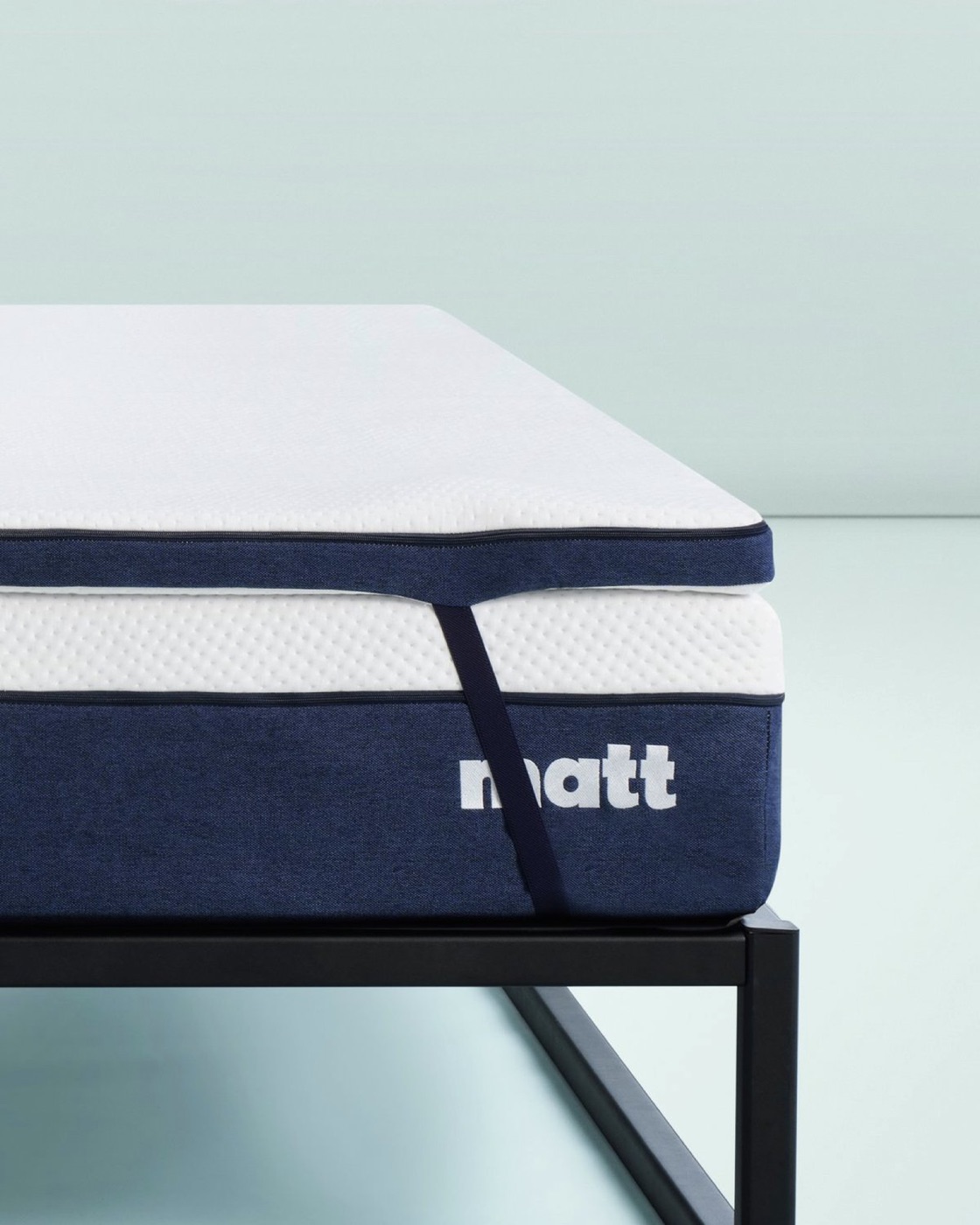
The surmatelas is 5 cm thick, double-sided — Hypersupport firm on one face, Hypersupport soft on the other — and made from foam the brand claims is twelve times more breathable than standard foam thanks to an AIR treatment that stops it trapping heat and moisture. The cover is Tencel, made from sustainably managed eucalyptus pulp, and washes at 60°C. Elastic straps on all four sides hold it in place.
Prices start at €187.50 for the smallest size, with 140×200 at €270. There is also a split version with a 70 cm cut at the top, for anyone with an adjustable electric bed made of two single mattresses who wants to close the gap in the middle — a specific problem that almost nobody solves well. The trial is 120 nights and the warranty two years, which is the honest asymmetry: a topper is a consumable, and it is priced and guaranteed like one.
The Topper Pro at €384 for 140×200 is the step up, using small foam springs rather than flat foam for support and ventilation. If your mattress is genuinely past it, a topper will not save it. If it is merely too firm, this is the cheapest correct answer in the range.
Beds and bases, for anyone furnishing the room rather than replacing a mattress
This is where a home blog has a real reason to look at this brand rather than any of the dozens of online mattress companies. The range extends to the frame.
The Storage Bed is the one that changes what a room can do. It starts at €1,470.47 for 140×200 and reaches €1,507.33 at 160×200, with a clean-lined upholstered frame and storage hidden under the mattress. In a flat where the constraint is floor area rather than budget, a bed that swallows the contents of a wardrobe is worth more than the square metres it saves.
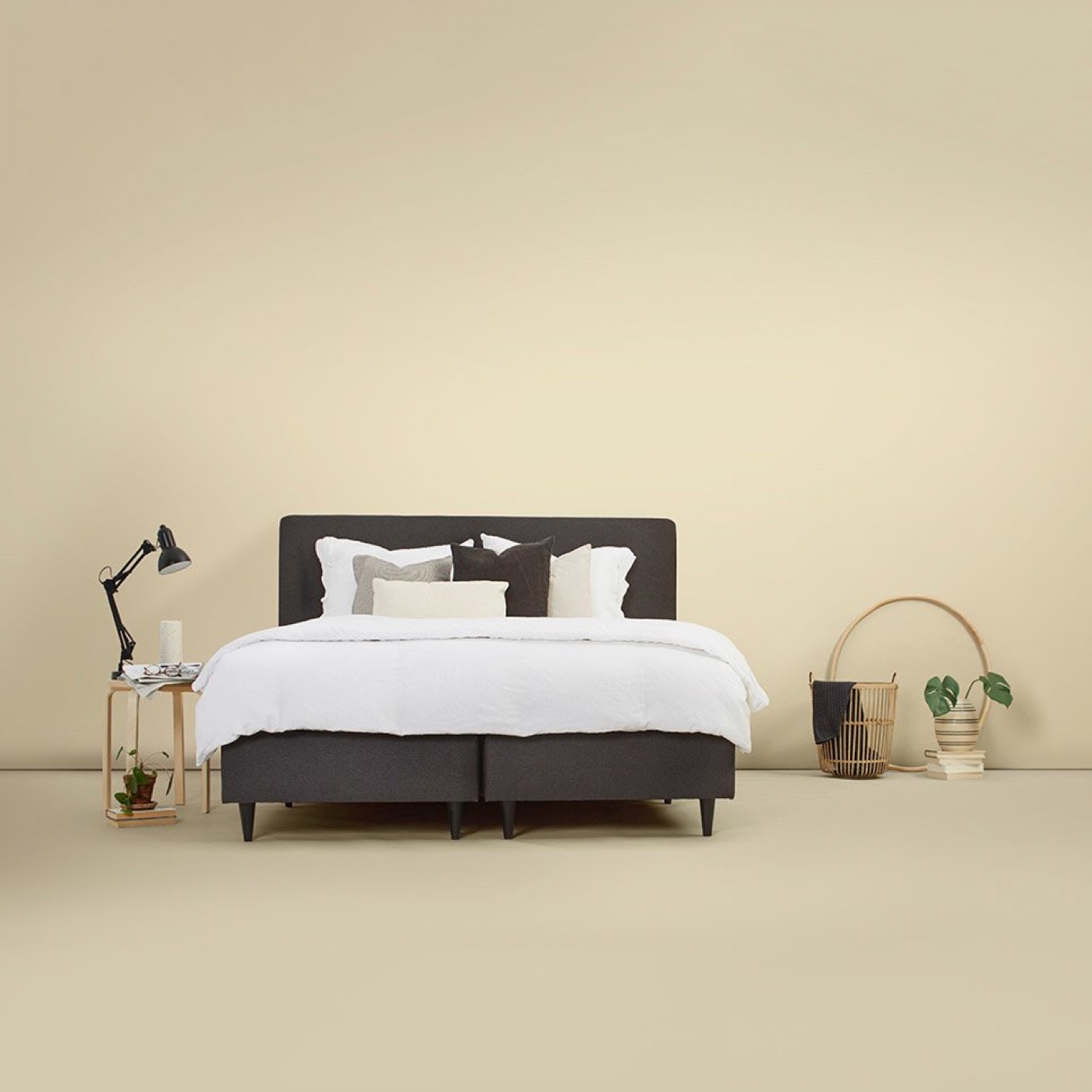
The Original Boxspring runs from €656.94 in 90×200 to €1,033.78 in 140×200 and €1,094.89 in 160×200, in beige, anthracite and blue. If you want a hotel-style bed without the hotel price, this is the honest way to get one, and the 20 cm-ish lift it gives a mattress changes the proportion of a low-ceilinged room more than paint does.
For a simpler frame, the Ease is €616 in 140×200 and €737.80 in 160×200 in grey or beige, with a crossed headboard and black or natural legs. It is the flat-pack-adjacent option and the one to consider if you are fitting out a spare room on a budget.
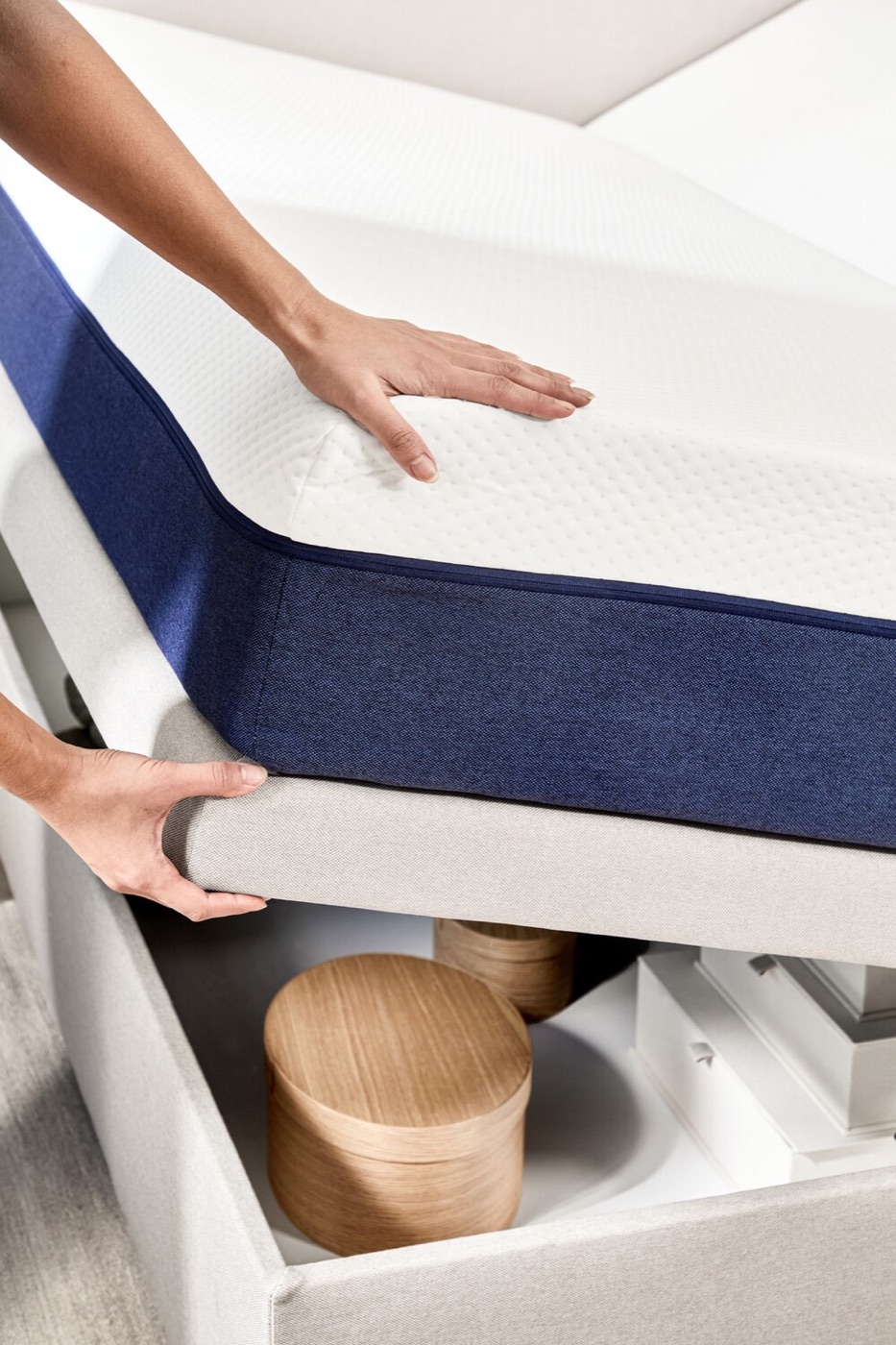
There is also a refurbished programme, which is easy to overlook and possibly the best value on the site. Mattresses that came back inside the trial window are inspected, reconditioned and resold — the 140×200 is €486.15, the 90×190 is €292.25. Same build, roughly 30 per cent off, and a second life for something that would otherwise be waste.
Pillows, duvets and the linen
The rest of the range is straightforward and, in places, genuinely good value.
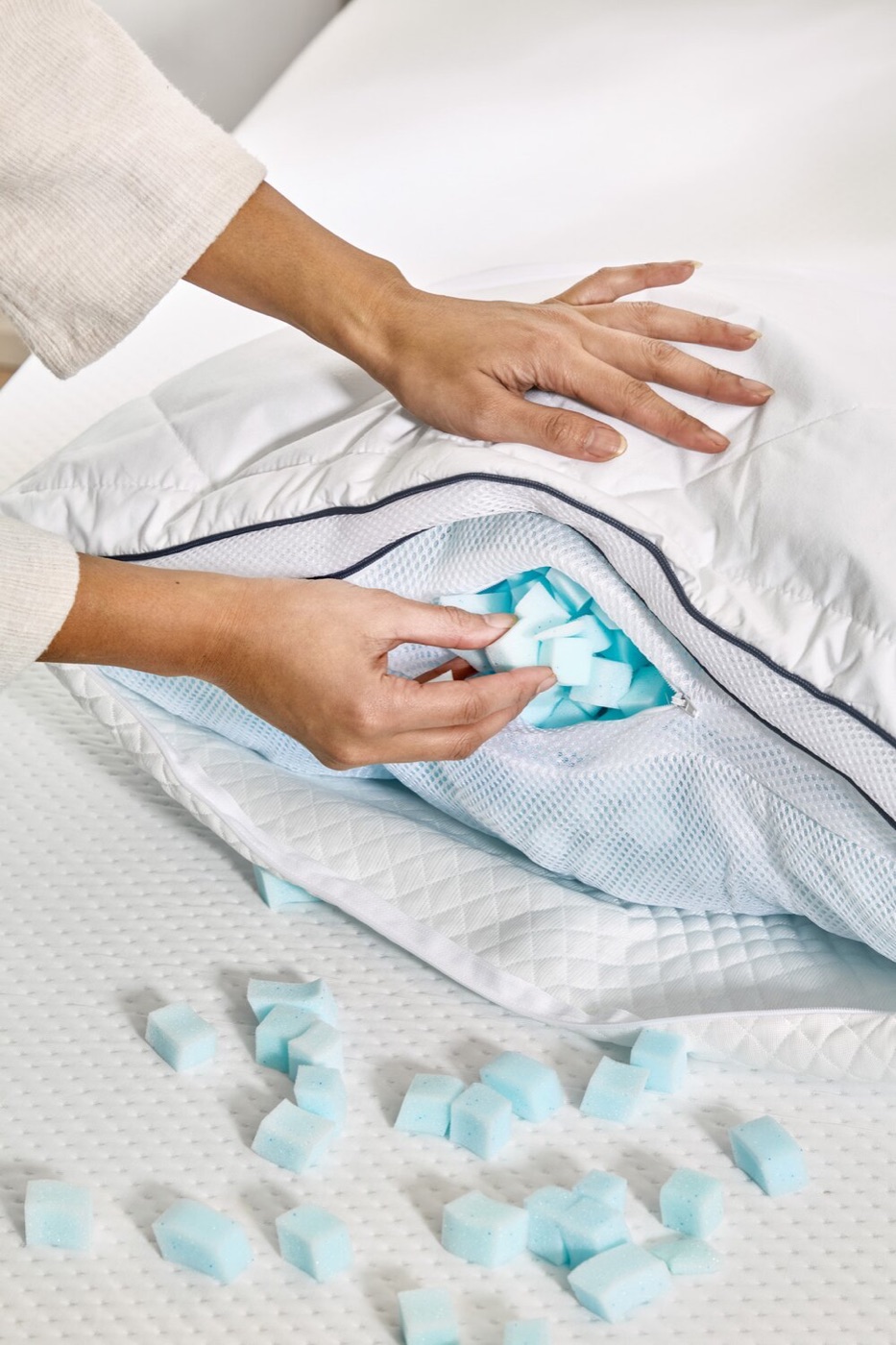
The adjustable pillow at €83.30 is the interesting one. It has a zip and comes with refill cubes, so you add or remove stuffing until the height is right — which solves the mismatch that ruins more nights than the mattress does. The memory foam pillow is €62.30, 12 cm thick, aimed at side and back sleepers, with a washable Tencel cover, hypoallergenic and OEKO-TEX certified, and a 30-night trial of its own.
Duvets come in two useful configurations. The Cloud all-season duvet is €120 in 140×200, €157.50 in 200×200 and €183.75 in 240×220, made from organic cotton, Tencel and fibre from recycled plastic bottles, with a 3D ventilation mesh and a 1-year warranty. The partner duvet at €206.25 for 200×200 is the answer to one person running hot and the other cold: one duvet, different warmth levels on each side, and it can be split into two separate duvets if the arrangement changes.
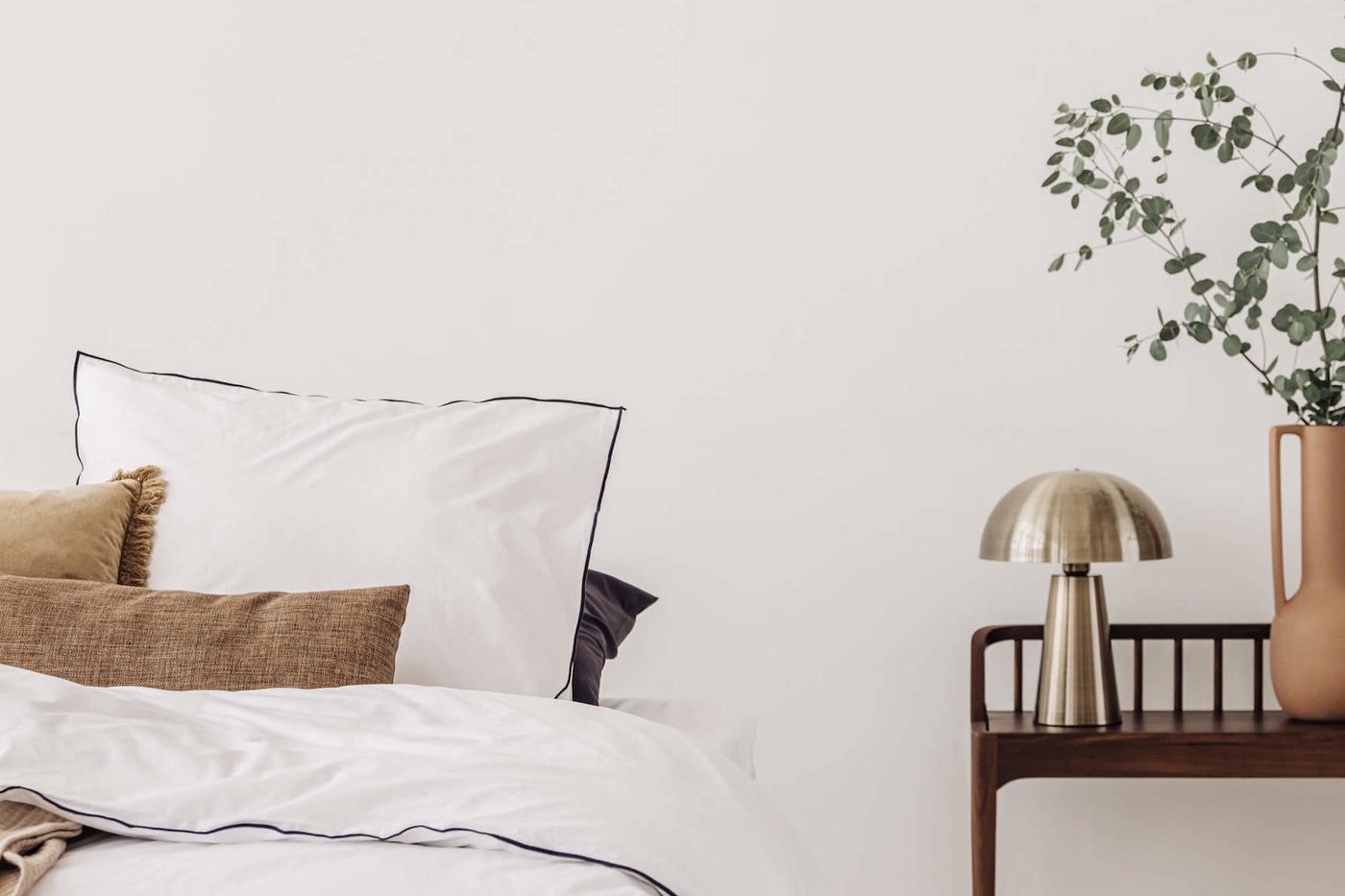
Linen is priced like a French bedding shop rather than a mattress add-on. Cotton percale sets start at €83.20 for 140×200 with one pillowcase, seersucker (200 TC, GOTS certified, non-iron) at €119.60, Egyptian cotton at €128.70 and cotton satin at €100.75. There is also a fitted sheet at €56 and — the most sensible purchase in the entire range — a waterproof, breathable cotton mattress protector at €51.80, washable at 60°C. Buy the protector before you buy anything else.

The honest caveats
A few things the product pages do not lead with.
The discount architecture is permanent theatre. Almost every product shows a struck-through "regular price" at exactly double the charged price, framed as Black Friday. That is not a seasonal deal, it is how the site is priced all year, and it means the saving you feel at checkout is largely notional. Judge the number, not the badge.
There is no showroom in France. With a Dutch brand selling across a border, you cannot lie on this mattress before ordering — the 120-night trial is the entire substitute for a showroom, and it is a good substitute, but it is not the same thing as testing a bed in a room with your own light.
The delivery window is quoted two different ways on the same site, three to five working days in one place and five to eight in another. Mattresses ship vacuum-packed in a box, which is convenient for stairs but means you should allow the stated time before you plan a first night on it, and expect a mattress in a box to need time to regain its shape.
The brand's sustainability language deserves a careful read. "Developed in Europe," water-based adhesives and reconditioned mattresses are all genuinely better than the alternative, but this is still a company selling new foam mattresses, and the refurbished programme is a good programme rather than a circular economy.
And the Hybrid Pro's current size availability in France is thinner than the marketing implies. Check the size you want before you build a plan around it.
Who it suits, and who it does not
The Original is for couples who disagree about firmness and are tired of one of them losing. The Hybrid Pro is for anyone with a specific back problem, an unusual body, or a history of buying mattresses that were nearly right. The topper is for anyone whose mattress is one notch too hard and who wants to spend €270 rather than €800. The storage bed is for a flat where the wardrobe is the problem. And the adjustable pillow at €83 solves the mismatch that most people blame on the mattress.
What it is not for: anyone who needs to lie on a bed in a shop before committing, or who wants a French-made product rather than a European one.
The verdict
The bedroom is the last room in the house you can still change completely, and most people leave it at whatever the last mattress shop sold them. Matt Sleeps makes a specific, defensible case that the fix is mechanical — a zip, six firmness levels, a partner who gets their own half, and a trial long enough that the decision stops being a gamble. The permanent discounts are noise and the delivery estimates are loose, but the build is legitimately certified, the awards come from bodies with no stake in the sale, and the range covers the room rather than just the middle of it.
For a room you use every night for a decade, that is a better proposition than four minutes on a showroom floor. The full range — mattresses, toppers, beds, boxsprings and linen — is here: 👉 Explore Matt Sleeps mattresses, beds and bedding